December 6, 2023

Dear Members,

In recent weeks, the AAUP-Penn Executive Committee has called on President Liz Magill to publicly condemn the targeted harassment of faculty members who have been subject to defamation and threats of personal violence for participating in the Palestine Writes Literature Festival and for expressing support for Palestinian civilians.  Campaigns of targeted harassment threaten core rights protected by academic freedom, including the rights of faculty to make academic decisions within their areas of expertise and to speak publicly on issues of general concern.  It is a fundamental duty of university administrators to condemn such attacks on academic freedom.

At yesterday’s Congressional hearings, some lawmakers contributed to the targeted harassment of faculty and subjected President Liz Magill to a line of questioning that revealed their contempt for academic freedom and for truth itself.  Unfortunately, in the face of their questions, President Magill failed once again to fulfill her responsibility to condemn targeted harassment.  During the hearing, Republican Congressmen Joe Wilson (R-SC) and Jim Banks (R-IN) breathed new life into a months-old campaign of targeted harassment by making false and inflammatory claims about individual Penn faculty members’ political views, affiliations, and activities.  They called on the University to commit flagrant violations of academic freedom: they suggested that Penn fire faculty members for protected extramural speech and challenged one faculty member’s right to teach classes and make curricular decisions within their area of scholarly expertise.  These were threats to the academic freedom of Penn faculty members made by members of Congress, broadcast live to international audiences and covered in major media outlets.  Such threats imperil the right of all faculty members to full freedom in research, teaching, and extramural speech.  At a time when the individual faculty members named by Congressmen Wilson and Banks have faced months of threats to their personal safety, often fueled by viral online misinformation, these comments also increase the serious risk of violence against members of our community.

President Magill failed to respond to these instances of targeted harassment that unfolded before her eyes.  While she was denied adequate time to respond, and while her testimony paid lip service to academic freedom, she did not challenge the Congressmen’s misleading claims about Penn faculty members. Nor did she challenge the legitimacy of the organized campaign of targeted harassment that has circulated these claims online and in the media for months.

Elsewhere in her testimony, President Magill accurately acknowledged “rising harassment, intimidation, doxing, and threats toward students, faculty, and staff based on their identity or perceived identity as Muslim, Palestinian, or Arab.” But she gave the inaccurate impression that the University has already taken effective action to address the problem of targeted harassment: “We are investigating all allegations, even when threats have come from outside our campus. We are providing resources and advice to assist individuals with online doxing, harassment, and threats. Safety and security for individuals and places of worship has been increased across the board, and we are deploying all necessary resources to support any member of our community who is the target of hate.”

In fact, as AAUP-Penn has documented, university policies have exhibited a pattern of discrimination against faculty and students—including Jewish members of our community—who have articulated criticisms of Israeli government policies or of the current war.  While offering free, enhanced security to some Jewish institutions, faculty, and students on campus, the university administration has failed to defend the safety and academic freedom of faculty and students who have voiced concern for Palestinian civilians.  These include Palestinian, Arab, and Muslim members of our community, Jewish students in Penn Chavurah, and faculty from other religious, national, and ethnic backgrounds.

As yesterday’s hearing made clear, the same groups outside the University that are threatening faculty members are attacking President Magill.  For the sake of the academic mission of our university, and for her own sake, she must refute their claims rather than accept their dangerous misrepresentations.  As the AAUP has explained, the attempts we are seeing at Penn and in Congress to conflate all research and teaching about Palestine and all criticism of Israeli government policies and warfare with antisemitism represent a direct threat to academic freedom.  They are designed not to fight antisemitism—a real and grave problem—but to suppress research and teaching on the histories, politics, and cultures of Israel and Palestine.  These are not only legitimate areas of scholarly inquiry; they are precisely the kinds of areas where searching, critical, and rigorous scholarly inquiry is needed to serve the public good in a democratic society.

President Magill has spent the last several months fruitlessly attempting to placate donors, trustees, members of Congress, and lobbying organizations that neither understand nor respect the principles of academic freedom—principles that the AAUP set out a century ago to safeguard the academic mission of the university.  President Magill has recapitulated their dangerous conflations of antisemitism with an overly broad range of academic programming and political speech and has tolerated and even contributed to the targeted harassment of faculty.  In doing so, she has not protected herself from criticism, but has emboldened attacks on faculty members, on academic freedom, and on the basic academic functioning of the University of Pennsylvania.  Yesterday’s Congressional hearing provided the clearest evidence yet that President Magill has committed a grave error in casting her lot with those who have threatened and humiliated her in order to instrumentalize her in a campaign against scholarship and teaching.  It is past time for the president of our university to stand up to these attacks by supporting in word and deed Penn’s faculty, the principles of academic freedom, and the fundamental scholarly mission of the university.

— AAUP-Penn Executive Committee

The policies of the University of Pennsylvania protect academic freedom, which is essential to the research and teaching mission of universities and to students’ freedom in learning. The concept of academic freedom was first articulated during the early twentieth century by the American Association of University Professors (AAUP), and its canonical definition is found in the AAUP’s 1940 Statement of Principles and 1970 Interpretive Comments. This statement has been endorsed by over 250 scholarly and educational organizations in the United States, and its principles are written into faculty handbooks nationwide, including Penn’s.

The principles of academic freedom were established to protect the integrity of research and teaching from interference by donors, trustees, politicians, and others who might seek to make universities serve private and political interests. They are founded on the idea that a university’s purpose is to generate new knowledge that can serve the common good in a democratic society, and that generating new knowledge requires free and open inquiry. To safeguard the university’s public mission, academic freedom entails the following rights for all faculty members—whether tenure-track or non-tenure track, and including graduate research and teaching assistants—and for students:

  • The right of faculty members to full freedom in research and teaching. This means that decisions about research and curricular matters are the province of faculty, who are hired on the basis of their professional qualifications in those areas. It also means that decisions about the hiring, promotion, and discipline of faculty members are to be made on the basis of their fitness to do the work of research and teaching, and determinations of fitness are made through formal, careful reviews by faculty members with the scholarly training to make informed evaluations. Academic decisions do not belong to trustees, donors, administrators, politicians, or others who lack academic expertise.

    Faculty members’ rights to freedom in research and teaching are not individual rights to say whatever one pleases in publications or in the classroom: a historian of Europe who espouses Holocaust denial or a biologist who teaches intelligent design is not protected by academic freedom because the academic profession in those fields has rejected those ideas as groundless and intellectually indefensible.  The rights to freedom in research and teaching are best understood as collective rights of the academic profession to determine the fitness of scholars to do the work of research and teaching within their areas of expertise, and they protect scholars who meet that standard from inappropriate pressure that would constrain free and open inquiry.

    Freedom in research and teaching is not a guild privilege: it is essential to students’ right to freedom in learning. It ensures that students take courses designed by qualified researchers and educators, not by donors, trustees, administrators, politicians, or others acting on the basis of non-academic preferences.

  • The right of faculty members to freedom in extramural speech—that is, speech on issues of general concern made as a member of the public. This right is necessary to protect freedom in research and teaching, as it prevents “pretextual” discipline—that is, cases in which trustees or administrators target a faculty member because they disagree with the substance of their scholarship, but rather than say so, they find a controversial statement that the professor has made in public and use that as the basis of discipline. This right protects speech made as a member of the public both within and beyond a faculty member’s area of expertise. According to the principles of academic freedom, extramural speech is not in itself grounds for discipline except in the rare case that it demonstrates unfitness to do the work of research and teaching. Such a determination must be made through a formal, careful review of evidence by faculty members.
  • The right of faculty members to freedom in intramural speech—that is, speech about the university itself that professors make as members of the institution. Faculty members have the right and responsibility to participate in the governance of their universities, and this right protects their ability to do so.  It establishes that faculty may not be disciplined for criticizing the university, as such threats of discipline would make it impossible for faculty to have a meaningful, independent institutional voice.
  • The right of students to freedom in learning. Codified in the AAUP’s 1967 Joint Statement on Rights and Freedoms of Students, this protects students’ freedom of expression and association, including the freedom to engage in political activity, all of which are essential aspects of learning and education. It also establishes that students are entitled to freedom of inquiry in the classroom. Finally, it stipulates that faculty do not evaluate students on the basis of their own or their students’ political views or activities. That ensures that faculty members and students can participate in public and political life without their speech threatening students’ freedom in learning.

These rights did not originate in the Constitution or in legislation, and they are not self-enforcing. Academic freedom is only as strong as the institutions, procedures, and professional norms that faculty members established over the last century to protect it:

  • Faculty governance institutions. Faculty across the United States incorporated AAUP principles into faculty handbooks, and they created Faculty Senates and faculty unions to enforce these policies.
  • Due process.  Written into Faculty Handbooks and union contracts, due process procedures protect all faculty members from unjust discipline or termination by requiring formal processes of review and appeal.
  • Tenure. The institution of tenure was created in order to protect academic freedom, on the understanding that job insecurity is the greatest threat to freedom in research and teaching.
Tagged with: ,

The AAUP–Penn Executive Committee issued the following message (also linked here as a PDF) today, November 28:

Dear Members,

The AAUP-Penn Executive Committee is deeply concerned to learn that the Penn administration has refused to allow a Jewish student organization, Penn Chavurah, to reserve a room this semester to screen Israelism, a documentary film about young Jewish Americans who have traveled to Israel and Palestine and developed critical perspectives on Israeli government policies. The administration’s refusal to allow students to screen a documentary film on campus is one more expression of our university leadership’s failure to uphold the principles of academic freedom—principles enshrined in Penn’s policies and essential to the mission of a university. Academic freedom entails the freedom of students to learn, and to encounter and critically examine multiple interpretations of the world. Students’ freedom to learn also entails their right to political speech and association, which are essential aspects of education and learning. In denying students these freedoms, the university administration violates its own policies and endangers the principles of academic freedom that are essential to the research and teaching mission of a university.

The Executive Committee commends our colleagues at the Middle East Center for reserving a room for the film screening, which as of now will take place tonight, November 28 at 6:30 p.m. in Meyerson Hall Room B1. We encourage all faculty members to attend to demonstrate their support for academic freedom. Should the screening site be moved, we will do our best to notify members. 

We are also gravely concerned by reports that administrators have allegedly told the Middle East Center to cancel the screening, and have allegedly informed Penn Chavurah that the group might lose its status or funding if tonight’s screening occurs

We are alarmed to learn that in response to this inappropriate pressure from administrators, the director of the Middle East Center submitted his resignation today. His resignation underlines the gravity of the crisis, and the responsibility the President and Provost have for creating and exacerbating it.  

We condemn in the strongest possible terms any pressure by administrators, donors, and trustees to prevent the Middle East Center from reserving a room to screen a documentary film that falls squarely within the Center’s area of expertise. It is the right of faculty members to make academic programming decisions.  We are particularly concerned that the Middle East Center has already lost its federal funding because the university failed to provide adequate support for its activities. Any further threats to the Center’s ability to fulfill its academic mission will only hurt our university, our faculty, and our students.

We have reported these concerns about academic freedom to the national office of the AAUP. We encourage departments, programs, and the Faculty Senate to speak out against this effort to suppress academic freedom.

— AAUP-Penn Executive Committee

AAUP-Penn Nov 28 Message on MEC Film Screening and Further Threats to Academic Freedom

Tagged with:

AAUP–Penn chapter President Amy Offner and Vice President Emily Steinlight contributed a guest column to the Daily Pennsylvanian, published on August 31 during the first week of classes, calling on faculty not to allow themselves to be used in Penn’s anti-union campaigns against student workers in GET-UP and United RAs at Penn. You can read our op-ed here.

This spring, we have been inspired by the growth of union organizing at Penn. Resident advisors who work in the dorms filed for a union election in March; graduate research assistants and teaching assistants in GET-UP went public with their organizing drive in April; and residents at Penn Medicine won their union election in May. Meanwhile, Penn Museum Workers United is pushing ahead with their campaign to win a first contract.

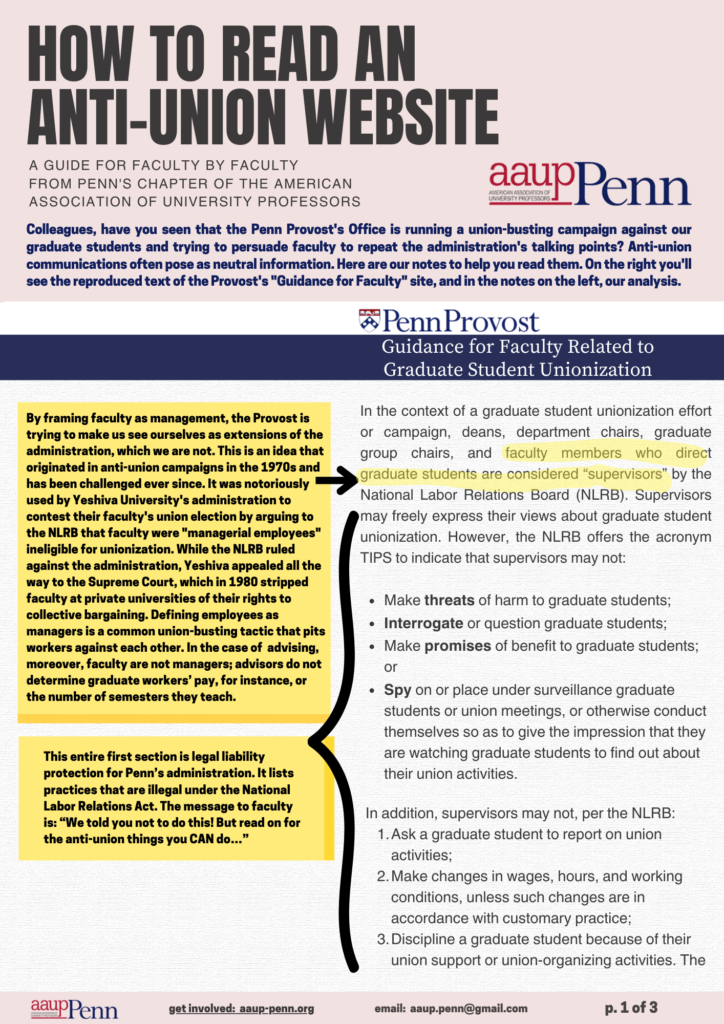
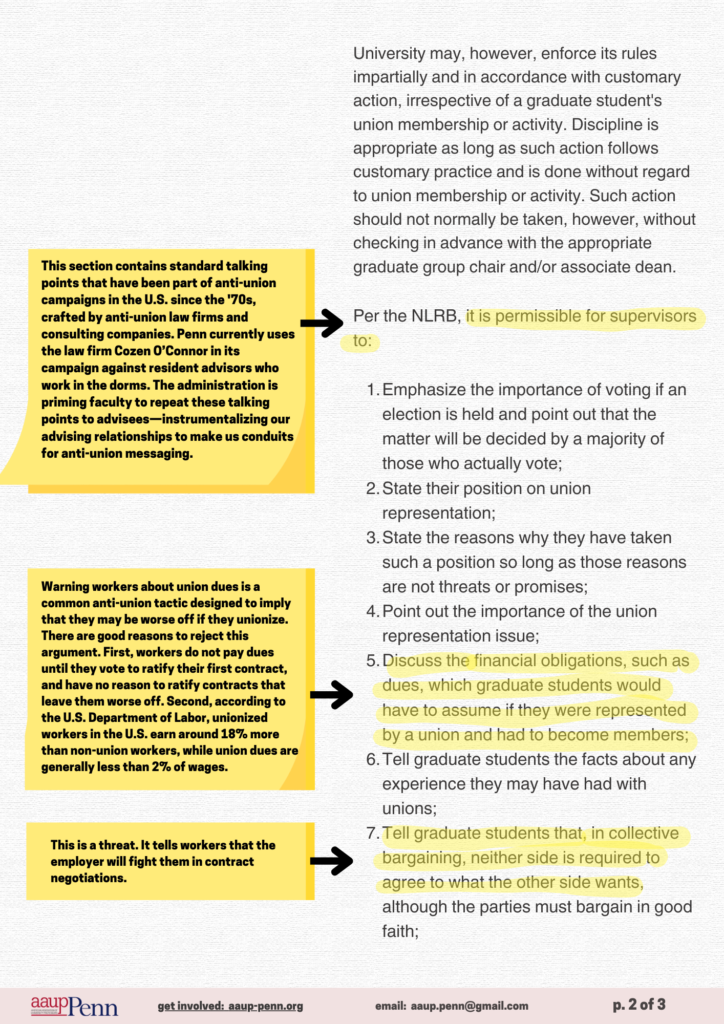
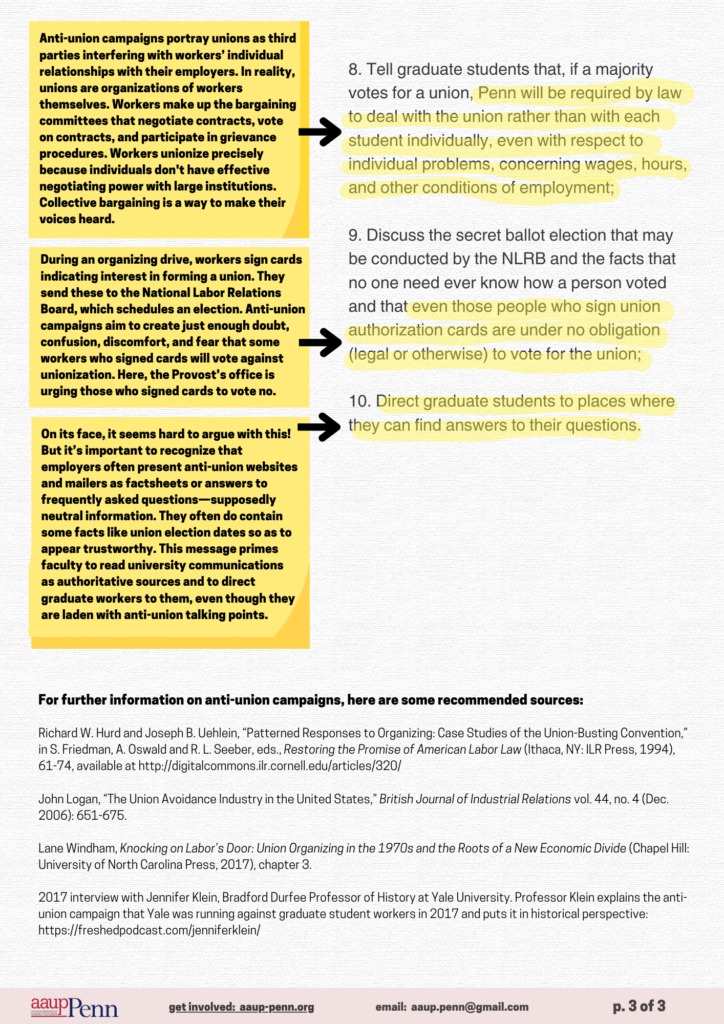
The university administration has launched anti-union campaigns in response to all these mobilizations and is now trying to enlist faculty in anti-union activity.  Just last week, all standing faculty in the School of Arts and Sciences received an email from administrators directing us to websites that present anti-union talking points for us to pass along to graduate student workers.  It is wrong for the administration to attempt to make us conduits for anti-union messages. Moreover, it is wrong for the administration to run anti-union campaigns at all.

Our Response

This week we delivered a letter to administrators calling on them to take down all anti-union websites and end the anti-union campaigns. We hope you’ll read and share it.

Together over the next several months, we will work to educate colleagues about anti-union campaigns to make sure that we do not pass along anti-union messages. As many of us know, anti-union campaigns can be subtle: employers present their communications as purportedly neutral answers to frequently asked questions.  As a result, even faculty who support unions might not immediately recognize these websites for what they are.  

To educate ourselves and our colleagues, we have created an annotated version of the Provost’s guidance to faculty. Please read it, share it with colleagues, and stay tuned for upcoming information sessions and opportunities to get involved. 

Tagged with: , , , , , ,

Our friends and colleagues in Penn Museum Workers United (AFSCME DC47 Local 397) are currently negotiating their first contract. They have waited long enough to do so (having organized in May 2021 and endured a relentless anti-union campaign), and there is a lot at stake: above all, wages that would allow them to live in dignity in Philadelphia. A third of PMWU members earn between $15.75 and $20 per hour; they are underpaid compared with their counterparts at other museums, as well as with Penn library workers who perform similar types of work and with Penn housekeeping workers in Teamsters Local 115. If the Museum can afford to spend $100 million on capital projects, it seems clear that it can also afford to pay its workers fairly. In fact, we believe that it can’t afford not to do so. It is in the interest of the institution to retain talented staff and prevent the high rates of turnover and instability that currently result from inadequate pay.

On June 4th, AAUP–Penn’s Executive Committee sent a letter to Penn President Liz Magill, Penn Museum Director Chris Woods, and Penn Museum Chief Operating Officer Genny Boccardo-Dubey calling on Museum management to accept the reasonable wage proposals of our colleagues in PMWU. You can read our letter below.

We stand in solidarity with Penn Museum workers, and we are committed to seeing that the University and the Museum meet their demands and negotiate a fair contract.

Tagged with: , , , ,

Yesterday, March 15, 2022, the Penn administration announced significant policy changes that eliminate indoor masking and other Covid-19 safety measures on our campus. To express the concerns and objections of many of our colleagues, AAUP–Penn’s Covid Response Task Force and the AAUP–Penn Executive Committee immediately drafted the following joint statement, which we sent to the Interim Provost and Interim President as well as the Faculty Senate Tri-Chairs today, March 16th:

***

Dear Interim President Wendell Pritchett, Interim Provost Beth Winkelstein, and Faculty Senate Tri-Chairs William W. Braham, Vivian L. Gadsden, and Kathleen Hall Jamieson,

Having heard from colleagues alarmed by the University’s March 15th announcement regarding policy changes that remove Covid-19 safety measures, the Penn chapter of the American Association of University Professors (AAUP–Penn) writes to share our collective concerns, and to ask the administration to reconsider these policies and provide clarification.

These abruptly announced policy changes are troubling and unsubstantiated by public health science:

  • Screening testing is now required only for those who are unvaccinated, are not yet fully vaccinated, or have not uploaded their booster information.
  • Masking is now optional in most indoor public spaces on campus, with the temporary exception of classrooms
  • Masking will no longer be required in classrooms after March 28.
  • Visitors to campus are no longer required to be fully vaccinated. 

March 28th is less than a month from the end of the academic year. We are unclear as to why there is such a rush to unmask at this late date in the semester, and these new guidelines raise a number of concerns. In particular:

Our students travel widely during spring break, including to countries with rapidly rising Covid-19 rates such as the UK (despite very high vaccination rates) and other countries that have considerably lower vaccination rates. In addition, wastewater testing shows case rates in the U.S. rising at 38% of testing sites over the past two weeks; 15% of wastewater sites tracked by the CDC showed an increase in Covid-19 levels up to 1000%. This data suggests, despite a temporary lull, that the pandemic is not over. Why eliminate screening testing altogether, rather than modify testing policy and wait to gather data about infection rates on campus? Penn claims to rely on its own scientific expertise, yet the findings of its clinical group that supposedly meets regularly to assess OpenPass guidelines and other Covid-19 policies are never shared. Relying for guidance on the city of Philadelphia, which may be basing its decisions on political pressure as much as public health information, seems out of keeping with the knowledge-driven mission of a research university like Penn.

Booster effectiveness has been shown to drop dramatically after 4 months, causing Pfizer to seek approval for fourth boosters for those 65 and older, a population that includes a significant number of faculty members. Although Penn may have set a deadline of January 2022 for boosters, many faculty, graduate students, and staff received their booster shots when they were first available in October 2021. Such personnel are likely much more vulnerable to the new BA.2 variant. Additionally, students who are immunocompromised or not comfortable going maskless may feel self-conscious about wearing masks in class once they are no longer required. The welfare of our students is a top priority for faculty, and we are concerned for vulnerable members of our classes. We are equally concerned for the safety of staff and campus workers, particularly those who work in densely populated indoor spaces.

In light of the above, many of our colleagues ask for and urgently need further explanation and reconsideration: 

  • Will instructors have the option to require students to wear masks in the classroom, even if Penn’s guidelines make masks optional?
  • Will faculty, grads, and staff with caregiving responsibilities for those in high risk categories, such as the elderly and children under 5 who cannot be vaccinated, be able to shift their teaching or work online if they can no longer expect students and those around them in their workplaces to wear masks? 
  • What steps are being taken to ensure that all students feel safe in common spaces, including immunocompromised, disabled, and other high-risk students? 
  • What steps are being taken to protect the health of staff in high-traffic spaces? 

We realize that some members of the Penn community may be eager to go “back to normal,” and we sympathize deeply with that wish. But we cannot wish away the recurring risks or the impact of the pandemic on the lives of faculty, grads, students, and staff. Some of us have lost family members to Covid, and many of us currently care for elderly parents. Some of us live with partners or family members who are immunocompromised, or are older or otherwise medically vulnerable ourselves, and a very large number of faculty and staff have children under 5 who are still unable to be vaccinated. A non-trivial proportion of contingent faculty who teach Penn students and an even higher proportion of subcontracted campus workers may not even have employer-provided medical coverage if they get sick while working on our campus; what will Penn do to keep them safe? From the start of the pandemic our chapter has asked the University to prioritize the wellbeing of the most vulnerable in our community. Removing even the most minimal forms of mitigation such as masking in our shared spaces now feels like organized abandonment. 

In the interest of our entire community, we urge Penn’s central administration to rethink and reverse these premature policy changes.

Tagged with: , ,

Yesterday, the AAUP–Penn Executive Committee issued this statement in a joint proposal with the LGBT Faculty Diversity Working Group to the Faculty Senate to extend parental leave policies to those bringing foster children into their homes:

On behalf of the American Association of University Professors chapter at Penn, we write to express our support for the proposed revisions to the faculty handbook regarding foster care. We agree with our colleagues in the LGBT Faculty Diversity Working Group that the current faculty handbook contains an oversight regarding foster care, which should be treated equally to other forms of bringing a child into the home in terms of parental leave. Correcting this oversight will have a positive impact for faculty of any identity who wish to bring a foster child into their home. But addressing this omission is even more important given that foster care affects some faculty more than others. In particular, the omission has a marked impact on LGBTQ+ faculty, who are up to 15 times more likely to be fostering a child than cis heteronormative faculty.

We urge the Faculty Senate to take action addressing this inequality and provide support for faculty who choose to become foster parents. At the same time, we would push the Faculty Senate and Penn Administration to address the egregious disparities in parental leave policies–for adoption, birth, and fostering–between standing and contingent faculty, as well as graduate students.  We believe that the benefits Penn offers to tenured and tenure-track faculty should be available to everyone who teaches and works at Penn.

In solidarity,
AAUP–Penn Executive Committee

Tagged with: , , , ,